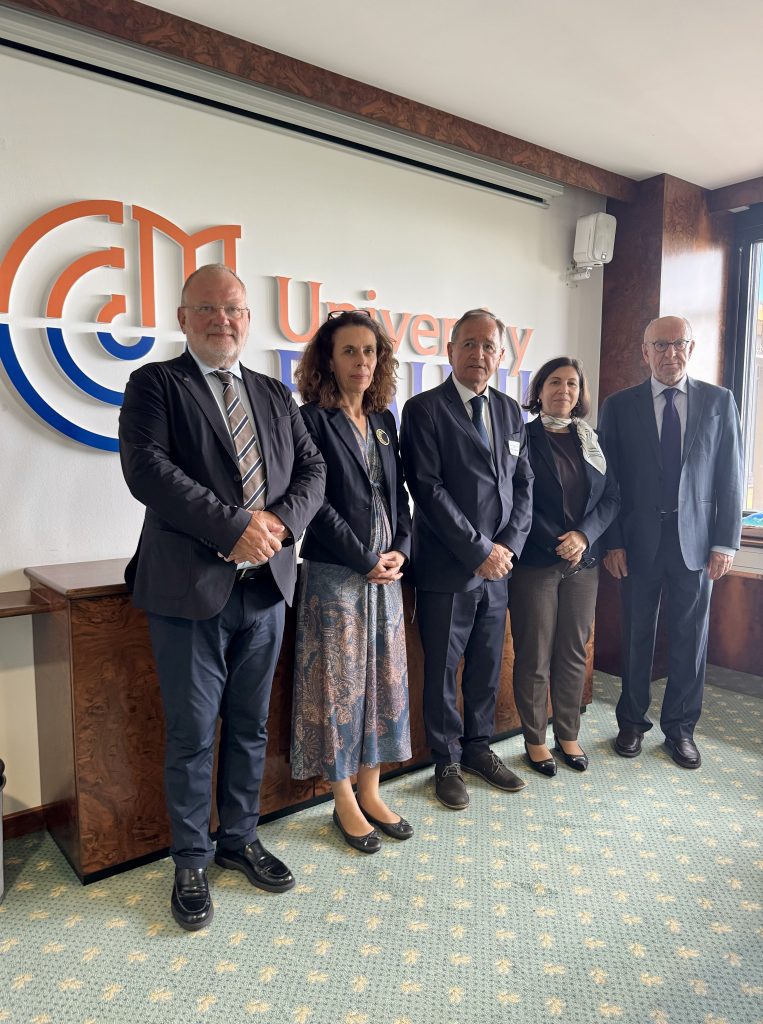
EMUNI hosted a high-level meeting bringing together:
Prof. Dr. Rado Bohinc, President of EMUNI University; Prof. Mouin Hamzé, Chairperson of the EMUNI Management Board; Ambassador Tanja Miškova, Ministry of Foreign and European Affairs of the Republic of Slovenia; and Teodoro Miano, Secretary General of the International Centre for Advanced Mediterranean Agronomic Studies (CIHEAM).
The discussion explored the respective roles and priorities of EMUNI and CIHEAM, opportunities for future collaboration, and the wider challenges facing the Mediterranean region.
The meeting took place alongside the international conference “Diplomacy 2.0: New Realities, New Agency, New Strategies,” held in Koper on 17–18 September 2026. The conference brings together diplomats, academics and experts to examine issues ranging from science diplomacy, research and higher education cooperation, sustainability and diplomatic communication to polycrisis, global value chains, multilateralism, geopolitics and changing forms of power.
A central point of the meeting was how the ideas discussed at the conference can move from dialogue to concrete cooperation.
In this context, EMUNI can play an important role as a Euro-Mediterranean platform connecting academia, diplomacy, institutions and regional partners — translating dialogue into education, research cooperation, institutional partnerships and initiatives with tangible impact across the Mediterranean.
The discussion also addressed how to further strengthen EMUNI’s positioning and its capacity to contribute to cooperation between the different shores of the Mediterranean, particularly through knowledge exchange, science and higher education diplomacy, and long-term institutional collaboration.
The conference itself reflects this approach, with a dedicated high-level panel involving representatives of EMUNI, CIHEAM, the Slovenian Ministry of Foreign and European Affairs, ALECSO and the Union for the Mediterranean.
Building bridges across the Mediterranean requires more than dialogue — it requires institutions capable of turning shared priorities into sustained cooperation.